
Vertical Mast vs. Telescopic Handler: Which Rough Terrain Forklift Is Better for Construction?
1. Introduction
Rough terrain forklifts play a critical role in modern construction projects where materials must be moved across uneven, muddy, or unpaved surfaces. Unlike warehouse forklifts, these machines are specifically engineered to operate outdoors in challenging environments while maintaining stability and lifting performance.
Among the most commonly used equipment in this category are vertical mast rough terrain forklifts and telescopic handlers (telehandlers). While both machines are designed to lift and transport materials on construction sites, they differ significantly in structure, capability, and application range.
A vertical mast forklift follows a traditional lifting design, using a straight, upright mast to raise and lower loads. It is simple, stable, and cost-effective, making it ideal for basic pallet handling tasks. In contrast, a telehandler uses an extendable boom system, similar to a crane, allowing it to reach higher and farther, making it far more versatile in complex construction environments.
Choosing between these two machines is not just a technical decision—it directly affects productivity, job site efficiency, safety, and overall project cost. This article provides a detailed comparison of both machines, examining design differences, lifting performance, terrain capability, attachments, cost, and real-world construction applications to help determine which solution is better suited for different job requirements.
2. What Is a Vertical Mast Rough Terrain Forklift?
2.1 Definition and Basic Concept
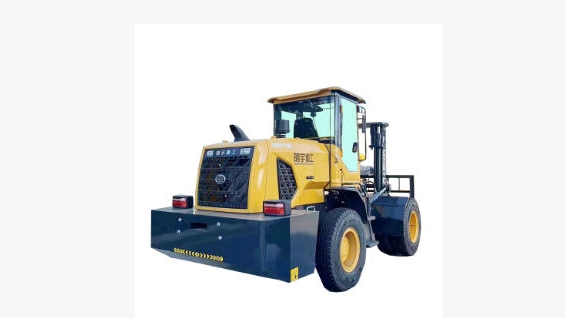
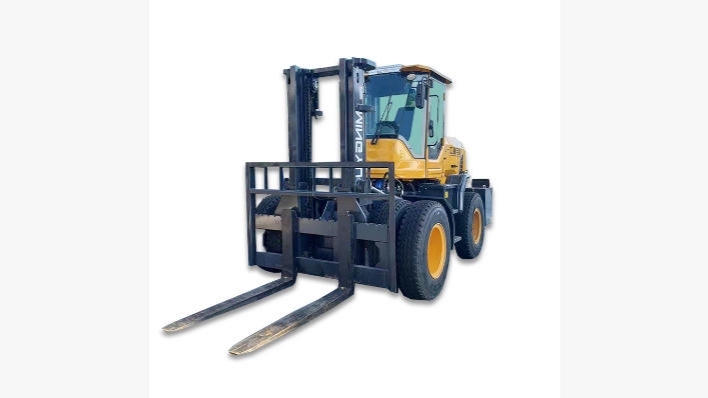
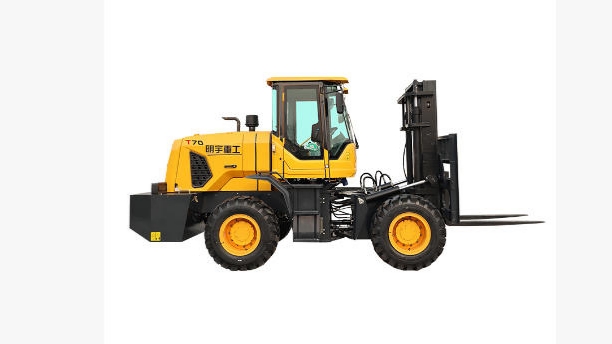
A vertical mast rough terrain forklift is a simplified off-road forklift designed for lifting and transporting palletized materials over uneven ground. It retains the core structure of a warehouse forklift but is reinforced for outdoor use.
2.2 Core Design Features
Vertical lifting mast system
Counterbalanced chassis design
Large pneumatic or foam-filled tires
Diesel-powered engine (most models)
Simple hydraulic lift and tilt system
2.3 Key Advantages
Vertical mast forklifts offer several benefits:
Lower purchase and operating cost
Simple operation and easy training
High stability when lifting vertically
Efficient for repetitive pallet handling tasks
Lower maintenance complexity
2.4 Limitations
However, they also have clear restrictions:
No forward reach capability
Limited lifting height compared to telehandlers
Less flexibility on complex job sites
Mainly suitable for ground-level logistics work
3. What Is a Telescopic Handler (Telehandler)?
3.1 Definition and Working Principle
A telescopic handler is a multi-purpose lifting machine equipped with an extendable hydraulic boom. It combines the functions of a forklift, crane, and small loader in one machine.
3.2 Core Design Features
Telescopic boom arm with hydraulic extension
Four-wheel drive and steering modes
Stabilizers or outriggers (on some models)
Interchangeable attachment system
High ground clearance for rough terrain
3.3 Key Advantages
High lifting height and reach
Excellent versatility with multiple attachments
Ability to lift over obstacles
Strong performance on uneven terrain
Can replace multiple machines on site
3.4 Limitations
Higher purchase cost
More complex operation and controls
Requires trained operators
Higher maintenance and repair costs
4. Structural and Design Differences
4.1 Mast vs. Telescopic Boom Design
Vertical mast forklifts use a straight-up lifting system, while telehandlers use a hydraulic boom that extends forward and upward. This fundamental difference defines their capabilities.
4.2 Stability Mechanism
Vertical mast forklifts rely on counterweight balance
Telehandlers rely on chassis design and sometimes outriggers for stability at height
4.3 Frame Construction
Telehandlers require a much stronger frame to support boom stress, while vertical mast forklifts have simpler structural requirements.
5. Lifting Performance Comparison
5.1 Maximum Lift Height
Vertical mast: limited vertical reach
Telehandler: significantly higher lifting height (often 6–20+ meters depending on model)
5.2 Load Capacity Behavior
Vertical mast: stable lifting capacity within rated range
Telehandler: capacity decreases as boom extends outward
5.3 Working Reach
Telehandlers can lift forward over obstacles, while vertical mast forklifts can only lift vertically.
6. Terrain Capability and Mobility
6.1 Off-Road Performance
Both machines are designed for rough terrain, but telehandlers typically have better traction systems and higher ground clearance.
6.2 Maneuverability
Vertical mast forklifts: tighter turning radius, easier in confined spaces
Telehandlers: slightly larger footprint but more versatile positioning
6.3 Site Suitability
Forklifts: small to medium job sites
Telehandlers: large construction sites with complex material movement needs
7. Attachments and Versatility
7.1 Vertical Mast Forklift
Mainly fork attachments
Limited customization options
7.2 Telehandler
Forks
Buckets
Jibs and winches
Work platforms
Material handling hooks
7.3 Functional Flexibility
Telehandlers can replace multiple machines, reducing equipment needs on site.
8. Operator Comfort and Safety
8.1 Cab Design
Telehandlers often feature larger, more advanced operator cabins compared to basic forklift cabs.
8.2 Visibility
Forklifts: mast can obstruct forward visibility
Telehandlers: boom may affect visibility at full extension
8.3 Safety Systems
Load moment indicators (telehandlers)
Stability control systems
Overload protection features
9. Hydraulic and Control Systems
9.1 Vertical Mast Hydraulics
Simple lift-and-tilt hydraulic circuits with minimal complexity.
9.2 Telehandler Hydraulics
Multi-function hydraulic systems controlling boom extension, lift, and attachments simultaneously.
9.3 Control Interface
Forklifts: basic lever controls
Telehandlers: advanced joystick and electronic systems
10. Cost Comparison
10.1 Purchase Cost
Vertical mast forklifts: lower cost
Telehandlers: significantly higher investment
10.2 Operating Cost
Forklifts: lower fuel and maintenance costs
Telehandlers: higher operating and service costs
10.3 ROI Consideration
Telehandlers may justify higher cost through multi-function use and reduced need for additional equipment.
11. Maintenance and Durability
11.1 Service Complexity
Forklifts are easier and cheaper to maintain due to simpler systems.
11.2 Wear Factors
Telehandlers experience higher stress on boom and hydraulic components.
11.3 Long-Term Reliability
Both machines are durable, but forklifts generally have fewer failure points.
12. Best Applications in Construction
12.1 Vertical Mast Forklift Applications
Basic material delivery
Ground-level pallet handling
Small construction logistics tasks
12.2 Telehandler Applications
High-rise construction
Bridge and infrastructure projects
Lifting materials over obstacles
Multi-stage job site logistics
13. Which Machine Should You Choose?
13.1 Key Decision Factors
Required lifting height
Site size and complexity
Budget availability
Need for multi-function capability
13.2 Contractor Type Consideration
Small contractors: vertical mast forklift is often sufficient
Large contractors: telehandler provides better flexibility and productivity
14. Future Trends in Rough Terrain Forklifts
14.1 Electrification
Growing adoption of electric and hybrid models for lower emissions.
14.2 Smart Technology
Load monitoring systems
AI-assisted stability control
Telematics and fleet tracking
14.3 Hybrid Machine Development
Machines combining forklift simplicity with telehandler versatility.
15. Conclusion
Vertical mast rough terrain forklifts and telescopic handlers serve different roles in construction environments. Vertical mast forklifts are simple, cost-effective, and highly stable for basic pallet handling tasks. Telehandlers, on the other hand, offer superior reach, versatility, and adaptability for complex construction operations.
The best choice depends entirely on job site requirements. For simple material handling tasks, a vertical mast forklift is often sufficient. For demanding, multi-layered construction projects, a telehandler provides significantly greater value and productivity.
Post time:May.21.2026
