
The central question of whether rough terrain forklifts are equipped with 4x4 or 2WD capability is fundamental to understanding their design philosophy and operational scope. Unlike their warehouse-bound counterparts, rough terrain forklifts are engineered explicitly for the unforgiving conditions of construction sites, lumber yards, agricultural fields, and other off-pavement environments. These settings are characterized by mud, loose gravel, sand, steep inclines, and deeply rutted pathways, which pose significant challenges to mobility and traction. In response to these demands, the overwhelming industry standard and engineering consensus heavily favor a robust 4x4 (four-wheel drive) system. This configuration is not merely an optional luxury but a core component that defines the very essence of a "rough terrain" machine, enabling it to navigate obstacles and maintain productivity where standard 2WD forklifts would inevitably become stuck or unstable. The presence of a powerful 4x4 drivetrain is, therefore, a key differentiator, separating all-terrain specialists from merely solid-tired forklifts that might venture outdoors occasionally.

The engineering rationale for the dominance of 4x4 systems in this sector is rooted in physics and practical necessity. A 2WD configuration, typically powering only the rear wheels, suffers from a critical limitation in weight distribution and traction application. A laden forklift carries its immense load over its front axle, which consequently bears the majority of the machine's total weight. If only the rear wheels are driven, they have significantly less downward force and thus less grip, especially when the forklift is carrying a load. This leads to a high probability of wheel spin and loss of forward momentum on any slippery or soft surface. A 4x4 system solves this problem by delivering power to all four wheels. This ensures that the front wheels, which are under load and are often the ones encountering an obstacle first, have the torque needed to pull the entire machine through difficult patches. Furthermore, the engagement of all four wheels dramatically enhances lateral stability, reducing the risk of tipping on uneven ground, a paramount safety concern. Features like limited-slip differentials or locking differentials are often integrated into these 4x4 systems to maximize traction even if one wheel loses contact with the ground entirely.
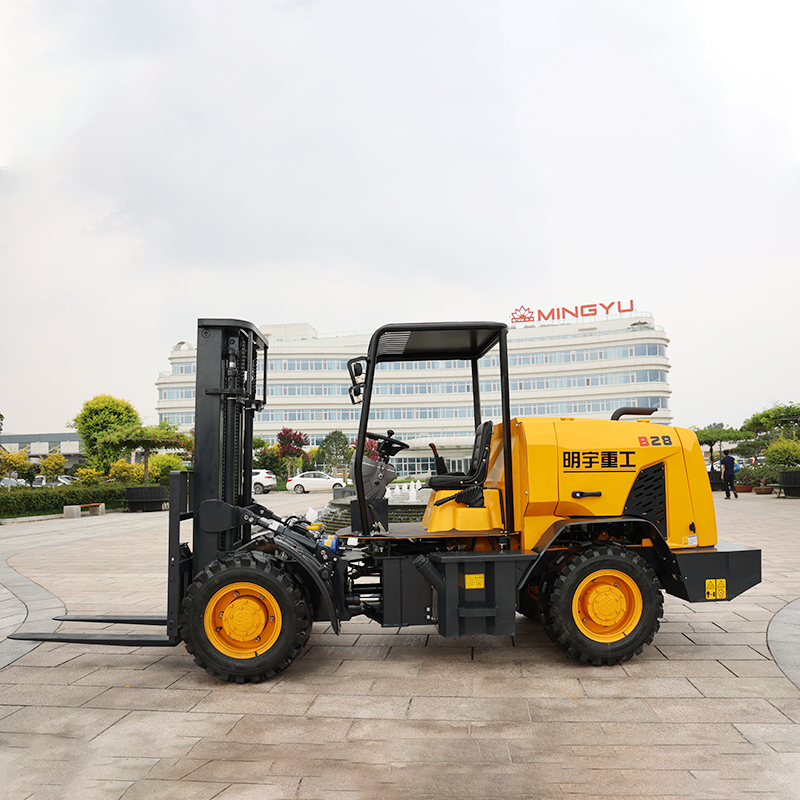
While 4x4 is the definitive standard, it is technically possible to find or configure a 2WD rough terrain forklift, but its applications are severely limited and it represents a niche offering. A 2WD model might be considered for consistently firm and flat surfaces, such as a packed gravel yard with minimal grade, where the primary need is for flotation over pavement rather than extreme traction. However, opting for 2WD sacrifices a tremendous amount of the machine's core utility and safety margin. The moment conditions become damp, uneven, or sloped, the 2WD forklift's performance will plummet. It becomes a significant operational liability, prone to getting stuck and unable to access more challenging parts of a worksite, thereby defeating the purpose of a rough terrain design. Consequently, for over 95% of scenarios that demand a rough terrain forklift, the 4x4 capability is non-negotiable. It is the defining feature that guarantees operational continuity, safety, and a return on investment in the harsh environments for which these machines are built.
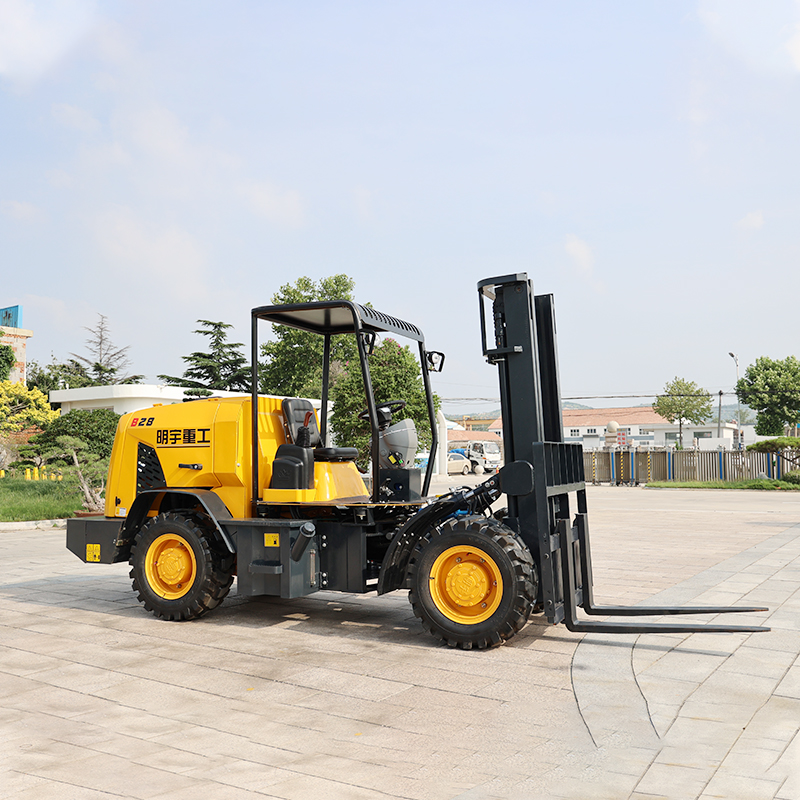
In conclusion, when evaluating rough terrain forklifts, the expectation should firmly be on finding a capable 4x4 system. This drivetrain is the cornerstone of their off-road performance, providing the necessary traction, push, and stability to handle heavy loads on unstable surfaces. Potential buyers should prioritize 4x4 capability and evaluate the specific features of the drivetrain, such as differential locks and the ease of engaging the four-wheel drive. Understanding this fundamental aspect ensures that the equipment purchased is truly fit-for-purpose, capable of enhancing site productivity and safety, rather than becoming a bottleneck. The investment in a genuine 4x4 rough terrain forklift is an investment in unwavering site access and reliable material handling, regardless of what the terrain presents.
Post time:Nov.17.2025
