
What Is the Required Aisle Width for Operating a Pallet Stacker?
1. Introduction: Why Aisle Width Matters in Warehouse Operations
In modern warehouses and logistics centers, space efficiency plays a crucial role in operational productivity and cost control. One of the most important design elements in warehouse planning is aisle width, especially when using material handling equipment such as pallet stackers. Pallet stackers are widely used for lifting, transporting, and stacking pallets in warehouses, retail storage areas, factories, and distribution centers. However, if aisles are too narrow, operators may struggle to maneuver safely; if they are too wide, valuable storage space may be wasted. Therefore, determining the correct aisle width for pallet stacker operations is essential for achieving both safety and efficiency. Proper aisle width ensures smooth movement of equipment, reduces the risk of accidents, and maximizes storage capacity.
2. Understanding Pallet Stackers and Their Applications
A pallet stacker is a type of warehouse equipment designed to lift pallets to a certain height and transport them over short distances. Compared with forklifts, pallet stackers are usually smaller, more compact, and easier to operate in confined spaces. They are commonly used in small to medium warehouses where space is limited. There are several types of pallet stackers, including manual stackers, semi-electric stackers, and fully electric stackers. Manual stackers rely on hydraulic pumping and manual movement, while electric stackers use electric motors for lifting and driving. Because of their compact design and flexibility, pallet stackers are ideal for stacking pallets on racks, loading goods in warehouses, and handling materials in retail or manufacturing environments.
3. Typical Aisle Width Requirements for Pallet Stackers
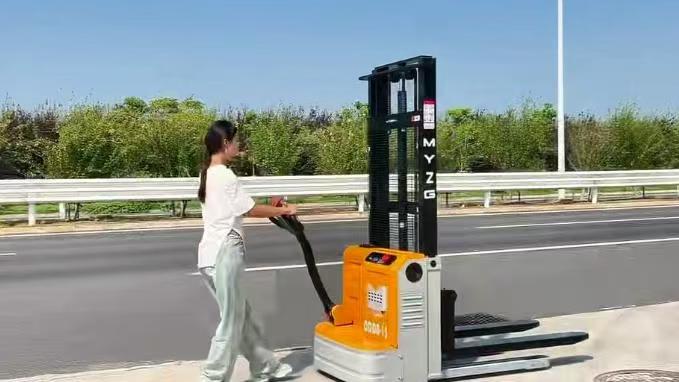
The required aisle width for pallet stacker operation varies depending on the equipment type, load size, and warehouse layout. Generally speaking, walk-behind electric pallet stackers require an aisle width ranging from approximately 2.0 to 2.5 meters (6.5 to 8.2 feet). Ride-on pallet stackers may require slightly wider aisles, typically between 2.5 and 3.0 meters (8.2 to 9.8 feet). In comparison, standard forklifts often require aisle widths of 3.5 meters or more. This means pallet stackers are ideal for narrow warehouse environments where maximizing storage density is important. However, the exact aisle width should always be determined according to the equipment specifications provided by the manufacturer.
4. Key Factors That Determine Aisle Width
Several factors influence the aisle width required for operating a pallet stacker. The first factor is the overall size of the stacker, including its length, width, and turning radius. Larger machines naturally require more maneuvering space. The second factor is the pallet size and load dimensions. Standard pallets may fit easily within narrow aisles, but oversized loads may require additional clearance. Another important factor is the stacking height and rack configuration, which may affect how operators approach racks and position loads. Additionally, safety clearance must be considered to allow operators to maneuver comfortably without risking collisions with racks, walls, or other equipment.
5. How to Calculate Minimum Aisle Width
Warehouse planners often calculate minimum aisle width using equipment specifications and load dimensions. A simplified method includes adding the stacker’s turning radius, the pallet length, and a safety clearance margin. For example, if a pallet stacker has a turning radius of 1.5 meters and the pallet length is 1.2 meters, the minimum aisle width may be around 2.7 meters after including additional maneuvering space. Manufacturers typically provide a specification called “Ast” or “right-angle stacking aisle width,” which represents the minimum aisle width required for safe operation. Using this value is the most accurate way to determine aisle requirements when designing a warehouse layout.
6. The Impact of Pallet Size on Aisle Width
Pallet size plays a major role in determining aisle width. Standard pallets vary across different regions of the world. For example, European pallets are typically 1200 × 800 mm, while North American pallets are often 48 × 40 inches. When pallets are handled lengthwise or sideways, the required turning space changes. Longer loads require wider aisles because they extend further from the stacker forks during turns. In warehouses that handle non-standard or oversized pallets, additional aisle space must be considered to prevent damage to racks and goods.
7. Narrow Aisle Warehouse Design
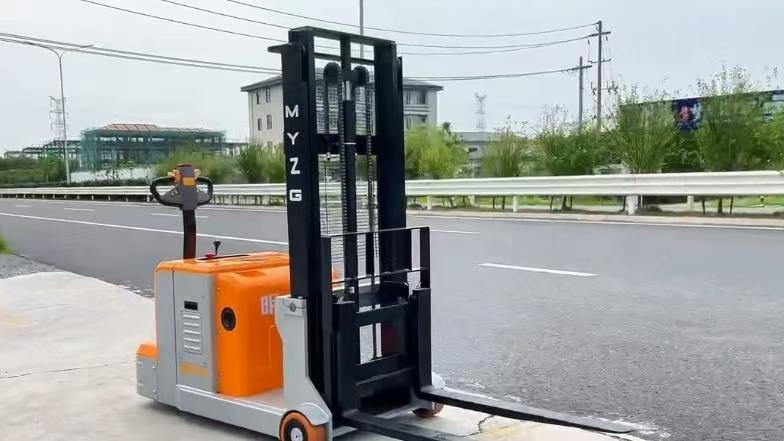
Many modern warehouses adopt narrow aisle designs to maximize storage capacity. Narrow aisle warehouses allow more racking rows within the same building footprint, significantly increasing storage density. Pallet stackers are particularly suitable for these environments because of their compact size and maneuverability. However, extremely narrow aisles may require specialized equipment such as reach trucks or very narrow aisle (VNA) forklifts. When planning a narrow aisle warehouse, businesses must balance storage capacity with equipment capabilities and operational efficiency.
8. Safety Considerations in Aisle Width Planning
Safety should always be a top priority when determining aisle width. Insufficient aisle space can lead to collisions, damaged goods, and injuries. Operators must have adequate visibility and maneuvering space when transporting loads. In warehouses where pedestrians share space with equipment, additional clearance should be provided to ensure safe movement. Clear aisle markings, safety mirrors, and proper operator training can also help reduce the risk of accidents. Designing aisles that allow smooth traffic flow is essential for maintaining a safe working environment.
9. Optimizing Warehouse Space with the Right Aisle Width
Choosing the correct aisle width for pallet stacker operations can significantly improve warehouse efficiency. Businesses should carefully evaluate their equipment specifications, pallet sizes, storage racks, and operational needs when planning aisle layouts. Using compact electric pallet stackers, optimizing rack spacing, and implementing efficient warehouse management systems can help maximize storage density without compromising safety. Ultimately, the right aisle width allows warehouses to achieve higher productivity, better space utilization, and smoother material handling operations.
Post time:Mar.16.2026
