
Can a Pallet Stacker Be Used Outdoors on Rough Terrain?
1. Introduction
Pallet stackers are widely used in warehouses, factories, distribution centers, workshops, and other material-handling environments. They are designed to lift and move palletized loads efficiently while requiring less space than many conventional forklifts. However, not every pallet stacker is suitable for outdoor operation, especially when the working surface is uneven, loose, wet, or otherwise challenging.
Whether a pallet stacker can be used outdoors on rough terrain depends mainly on its design, tires, ground clearance, stability, power system, and the actual conditions of the worksite. A standard warehouse pallet stacker is normally designed for smooth and level floors. Using this type of machine on gravel, muddy ground, steep slopes, or heavily uneven surfaces can affect traction, stability, and operating safety.
Some specially designed stackers can handle limited outdoor applications, particularly on firm and relatively level surfaces. However, if the worksite has genuinely rough terrain, a rough-terrain forklift or another machine specifically designed for outdoor material handling may be more appropriate. Understanding these differences helps operators and equipment buyers select the right machine for the job.
2. What Is a Pallet Stacker?
A pallet stacker is a compact material-handling machine used to lift, transport, and stack pallets. It generally consists of a mast, forks, drive wheels, steering system, lifting system, battery or engine, and operator controls.
There are several common types of pallet stackers. Manual stackers use human power for some or all operations, while semi-electric models typically use electric lifting with manual movement. Fully electric pallet stackers use an electric drive motor and electric lifting system, making them suitable for frequent warehouse operations.
Their compact dimensions and relatively small turning radius are major advantages. They can operate in narrow aisles and storage areas where larger forklifts may have difficulty maneuvering. However, these same compact designs are usually optimized for controlled indoor environments rather than difficult outdoor terrain.
3. Why Rough Terrain Is Challenging for Pallet Stackers
Rough terrain creates several challenges that are not normally encountered on warehouse floors.
First, uneven ground can reduce the stability of the machine and its load. When a pallet stacker travels over a pothole or uneven section while carrying a raised load, the center of gravity can shift. This makes proper operating practices particularly important.
Second, loose surfaces such as gravel or soft soil can reduce traction. Small wheels designed for smooth floors may have difficulty maintaining sufficient grip.
Third, mud and standing water can create additional problems. They can reduce traction and potentially expose electrical or mechanical components to conditions for which they were not designed.
Slopes are another concern. A pallet stacker designed primarily for level floors may not have the traction, braking performance, or stability required for significant inclines.
For these reasons, the phrase "outdoor use" should not automatically be interpreted as "rough-terrain use." A paved loading yard and a muddy construction site are very different operating environments.
4. Can a Standard Pallet Stacker Be Used Outdoors?
A standard pallet stacker may be used outdoors in certain limited situations, but this depends on the manufacturer's specifications and the surface conditions.
For example, moving pallets across a flat, dry, paved loading area for a short distance may be possible if the machine is approved for that application. However, using a conventional indoor stacker continuously on gravel, dirt, grass, mud, or heavily uneven terrain may exceed its intended operating conditions.
Before using a stacker outdoors, operators should check the manufacturer's instructions for information about:
Approved operating surfaces
Maximum allowable gradients
Tire specifications
Ground clearance
Weather and water exposure
Load capacity
Operating temperature
Battery requirements
If the machine is specifically designed for indoor use, it should not be assumed that it can safely perform rough-terrain work simply because it has enough lifting capacity.
5. What Makes a Pallet Stacker Suitable for Rough Terrain?
A pallet stacker intended for outdoor applications needs features that address traction, stability, durability, and environmental exposure.
Larger tires can provide better clearance and improved ability to pass over small surface irregularities. Depending on the design, pneumatic or solid tires may also offer advantages over small warehouse wheels.
Higher ground clearance helps prevent the chassis and other components from contacting uneven ground.
A stronger chassis can be important when equipment is repeatedly exposed to outdoor operating conditions.
Better traction is especially important on gravel, compacted soil, and other surfaces where standard warehouse wheels may slip.
The lifting system should also be appropriate for the intended load. When operating on uneven ground, keeping the load low during travel is particularly important.
In addition, electrical components, connectors, batteries, and other systems should have suitable protection if the machine will regularly encounter dust, moisture, or changing weather conditions.
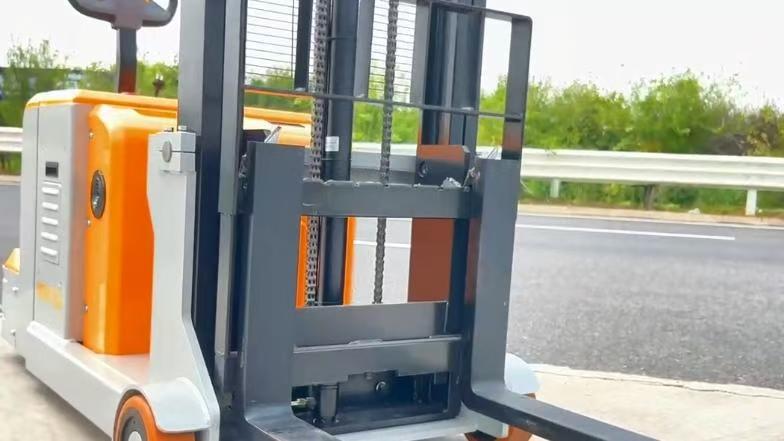
6. Rough-Terrain Pallet Stackers vs. Standard Pallet Stackers
The biggest difference between standard and outdoor-oriented equipment is the environment for which the machine is designed.
|
Feature |
Standard Pallet Stacker |
Outdoor/Rough-Terrain Equipment |
|
Main application |
Warehouses and factories |
Outdoor yards and uneven sites |
|
Typical surface |
Smooth concrete |
Gravel, compacted soil, paved outdoor areas |
|
Tires |
Compact warehouse wheels |
Larger outdoor-suitable tires |
|
Ground clearance |
Generally low |
Generally higher |
|
Traction |
Optimized for smooth floors |
Designed for more variable surfaces |
|
Stability requirements |
Level-floor operation |
Greater attention to uneven terrain |
|
Weather exposure |
Usually limited |
Better suited when specified |
|
Typical environment |
Indoor |
Outdoor |
It is important to note that there is no single design that makes a machine suitable for every type of rough terrain. Buyers should evaluate the exact conditions rather than relying only on the term "outdoor."
7. Tire Selection for Outdoor Pallet Stacker Operation
Tires have a major influence on outdoor performance.
Cushion or small solid wheels are common on warehouse stackers because they provide smooth operation on concrete and other hard floors. They are compact and require relatively little maintenance.
For outdoor applications, larger pneumatic tires can provide better performance on certain uneven surfaces because their construction can absorb some surface irregularities. Solid pneumatic-style tires can also provide puncture resistance while maintaining a larger profile.
However, tire selection should match the machine's complete design. Installing larger tires on a standard pallet stacker does not automatically convert it into a rough-terrain machine. Wheel size can affect ground clearance, steering, stability, gearing, and load characteristics.
Therefore, the safest approach is to select a machine and tire configuration recommended by the manufacturer for the intended outdoor conditions.
8. Important Ground Conditions to Consider
Not all outdoor surfaces present the same level of difficulty.
Concrete and asphalt: These are generally the easiest outdoor surfaces for a pallet stacker, provided the machine is approved for outdoor use.
Compacted soil: A suitable machine may operate effectively if the surface is firm, level, and free of large obstacles.
Gravel: Gravel can reduce traction and make small wheels less effective. Loose stones can also affect stability.
Grass: Firm, dry grass may be manageable for some equipment, but wet or soft grass can cause traction problems.
Mud: Mud presents significant traction and stability challenges and may not be suitable for standard pallet stackers.
Slopes: Inclines require special attention to braking, traction, load position, and manufacturer limits.
Potholes and uneven terrain: These can create sudden movements and affect the stability of both the machine and its load.
The actual surface condition should therefore be assessed before selecting the equipment.
9. Load Capacity and Stability Outdoors
A pallet stacker's rated capacity is normally specified under particular operating conditions. It does not mean that the machine can safely carry the maximum rated load over every type of terrain.
Load center is especially important. As the load center increases, the effective load moment also increases, potentially reducing the available lifting capacity.
Mast height also affects the center of gravity. A high load can make the machine more sensitive to uneven ground.
When traveling outdoors, operators should generally keep the forks and load as low as practical while maintaining adequate ground clearance. Sudden turns, high speeds, and uneven surfaces should be avoided.
For applications involving heavy loads on challenging terrain, the machine's load chart and manufacturer's operating limitations should always take priority.
10. Weather and Environmental Considerations
Outdoor use exposes pallet stackers to conditions that may be uncommon indoors.
Rain can make surfaces slippery and reduce traction. Water may also affect electrical connections if the machine does not have appropriate protection.
Dust and dirt can enter moving components and increase maintenance requirements. In agricultural or construction environments, airborne particles may be particularly common.
Temperature can also affect battery-powered equipment. Cold conditions may reduce battery performance, while very high temperatures can influence battery and electronic-system operation.
If a pallet stacker will be used outdoors regularly, buyers should ask the manufacturer about its environmental protection rating, battery operating temperature range, water resistance, and recommended storage conditions.
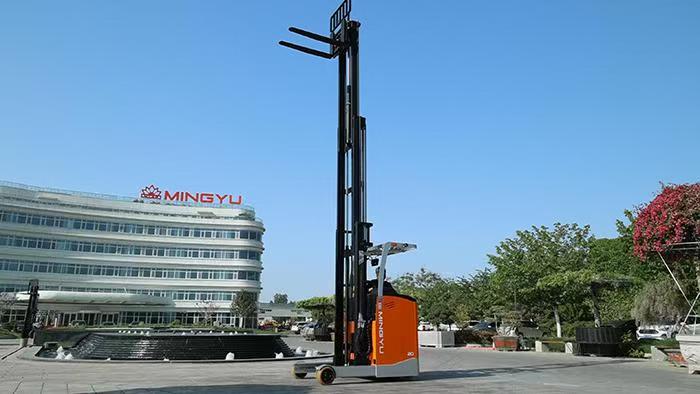
11. Safety Tips for Using a Pallet Stacker Outdoors
Before outdoor operation, inspect the machine carefully. Check the tires, forks, mast, brakes, steering system, battery, and visible electrical components.
The operator should also inspect the route. Remove obstacles where possible and identify potholes, soft ground, steep sections, and slippery areas.
When carrying a load:
Keep the load stable and properly positioned.
Keep the load low during travel.
Avoid sudden steering movements.
Operate at a controlled speed.
Avoid surfaces that exceed the manufacturer's limits.
Maintain clear visibility.
Follow the rated load capacity.
Use the machine according to the manufacturer's instructions.
Operators should also use appropriate personal protective equipment and receive proper training for the equipment they operate.
12. How to Choose a Pallet Stacker for Outdoor Applications
Start by defining the actual working environment rather than simply asking for an "outdoor pallet stacker."
Consider the following factors:
Load capacity: Determine the maximum pallet weight and required safety margin.
Lifting height: Identify the highest storage position the machine must reach.
Terrain: Determine whether the machine will operate on concrete, asphalt, gravel, soil, grass, or another surface.
Ground clearance: Higher clearance can be useful where uneven surfaces are expected.
Tires: Select tires according to the surface and manufacturer's recommendations.
Power system: Electric, lithium-ion, or other power systems may be suitable depending on operating hours and environmental conditions.
Weather exposure: If the machine will remain outside, protection from rain, dust, and temperature changes becomes more important.
Transport requirements: Consider whether the machine itself must frequently move between indoor and outdoor areas.
13. Common Outdoor Applications
With the appropriate machine configuration, pallet stackers can be useful in several outdoor or semi-outdoor applications.
These can include building-material storage areas, loading zones, agricultural facilities, small distribution yards, landscaping operations, and warehouses with outdoor staging areas.
For example, a warehouse may need to move pallets from an indoor storage area to a covered loading dock. A suitable stacker may perform this task effectively if the route is short and the outdoor surface is firm and level.
Construction sites are more challenging. If the surface contains loose soil, deep gravel, mud, large obstacles, or steep slopes, a conventional pallet stacker may not be the right equipment.
In such conditions, a rough-terrain forklift or another purpose-built machine may provide a more appropriate solution.
14. Maintenance of Outdoor Pallet Stackers
Outdoor operation can increase maintenance requirements.
After working in dusty or muddy environments, the machine should be cleaned according to the manufacturer's instructions. Mud and debris should not be allowed to accumulate around wheels, forks, mast components, or other moving parts.
Operators should regularly inspect:
Tires and wheels
Forks
Mast and chains
Hydraulic components
Brakes
Steering system
Battery and charging connections
Electrical connectors
Fasteners and structural components
Lubrication should be performed according to the recommended maintenance schedule. If the machine is exposed to rain or dust more frequently than expected, inspection intervals may need to be adjusted according to the manufacturer's recommendations.
15. Frequently Asked Questions
Can an electric pallet stacker work outside?
Yes, some electric pallet stackers can be used outdoors, particularly on firm and relatively smooth surfaces. The manufacturer's specifications should confirm whether outdoor operation is permitted.
Can a pallet stacker operate on gravel?
Some models may operate on compacted gravel, but standard warehouse stackers may have limited traction and ground clearance. The exact machine design and gravel condition must be considered.
Can a pallet stacker work on a slope?
Only within the slope limits specified by the manufacturer. Slopes can significantly affect traction, braking, and stability.
Are pneumatic tires better for outdoor use?
They can be advantageous on some uneven surfaces because of their larger size and ability to absorb surface irregularities. However, tire choice should be matched to the complete machine design and application.
Is a pallet stacker the same as a rough-terrain forklift?
No. A standard pallet stacker is generally designed for material handling on smooth floors, while a rough-terrain forklift is specifically engineered for more challenging outdoor surfaces.
What is the most important factor when using a pallet stacker outdoors?
The operating environment is one of the most important factors. Surface condition, slope, load, tire type, ground clearance, and weather exposure all need to be considered together.
16. Conclusion
A pallet stacker can be used outdoors in some applications, but a standard warehouse pallet stacker is generally not intended for genuinely rough terrain. Firm, level, paved outdoor areas may be suitable for certain models, while gravel, mud, soft soil, steep slopes, and heavily uneven ground require much greater consideration.
For regular outdoor operation, buyers should focus on tire design, ground clearance, traction, stability, structural strength, environmental protection, and manufacturer-approved operating conditions. If the worksite involves severe terrain or heavy loads, a purpose-built rough-terrain forklift may be a more suitable type of equipment.
Ultimately, the right choice depends on matching the pallet stacker's design and specifications to the actual surface, load, lifting requirements, and working environment. This approach helps improve operational efficiency while supporting safer material handling between indoor and outdoor work areas.
Post time:Sep.30.2026
