
What Is a Stack Electrical (Electric Stacker)? Complete Guide to Electric Stacker Trucks
1. Introduction
In modern logistics and warehousing, efficiency and safety are more important than ever. As businesses grow and storage demands increase, companies rely heavily on material handling equipment to move goods quickly and accurately. One of the most widely used machines in this field is the electric stacker, often referred to as a “stack electrical” in some markets.
An electric stacker is a compact, battery-powered machine designed to lift, transport, and stack pallets in warehouses, factories, and distribution centers. It is especially popular in indoor environments where space is limited and emissions must be controlled.
This article provides a complete guide to electric stackers, including what they are, how they work, their types, advantages, applications, operation methods, safety guidelines, and maintenance tips. Whether you are a warehouse manager, operator, or business owner, understanding this equipment can help improve productivity and reduce operational risks.
2. What Is a Stack Electrical / Electric Stacker?
An electric stacker is a type of material handling equipment that uses an electric motor and hydraulic system to lift and move palletized goods. It is designed primarily for stacking goods at different heights and transporting them over short distances.
Unlike traditional forklifts, electric stackers are more compact and are mainly used in indoor environments such as warehouses, retail storage areas, and manufacturing facilities.
The main functions of an electric stacker include:
Lifting pallets vertically
Stacking goods on shelves or racks
Transporting materials across short distances
Loading and unloading trucks in some cases
The key difference between a forklift and a stacker is that forklifts are more powerful and suitable for heavy-duty outdoor operations, while electric stackers are optimized for lighter loads and tighter spaces.
3. Types of Electric Stackers
Electric stackers come in different models depending on operational needs:
1. Walk-behind electric stackers
The operator walks behind the machine and controls it using a handle. These are ideal for small warehouses and light-duty tasks.
2. Ride-on electric stackers
The operator rides on the machine, making them suitable for longer distances and higher efficiency.
3. Semi-electric stackers
These use electric power for lifting but manual effort for movement. They are cost-effective and used in low-intensity operations.
4. Fully electric stackers
Both lifting and movement are powered by electricity, offering maximum efficiency and minimal physical effort.
5. High-lift stackers
Designed to reach higher shelves, commonly used in vertical storage warehouses.
6. Narrow aisle stackers
Specially designed for tight warehouse spaces where maneuverability is limited.
4. Main Components of an Electric Stacker
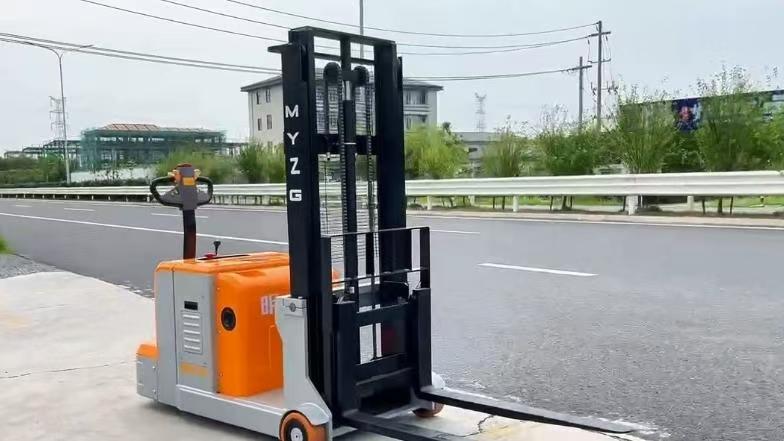
An electric stacker consists of several important parts:
Mast system: Responsible for vertical lifting
Forks: Support and carry the pallet load
Hydraulic system: Provides lifting power
Electric motor: Drives movement and lifting functions
Battery system: Supplies energy to the machine
Control handle: Used for steering and operation
Chassis and wheels: Provide stability and mobility
Each component plays a critical role in ensuring smooth, safe, and efficient operation.
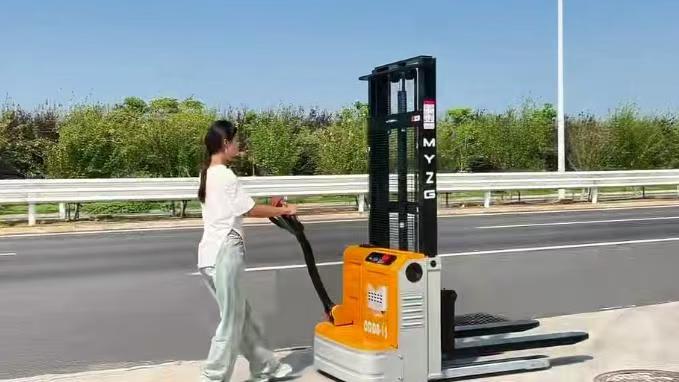
5. How an Electric Stacker Works
Electric stackers operate using a combination of electrical and hydraulic systems.
When the operator activates the controls, the battery supplies power to the electric motor. This motor drives the hydraulic pump, which lifts the mast and forks. The operator can raise or lower the load using control levers on the handle.
Movement is controlled electronically or semi-electrically, depending on the model. Steering is usually achieved through a handle system that allows precise maneuvering in tight spaces.
Charging is done through an external charger, and most modern stackers can operate for several hours on a single charge, depending on usage intensity.
6. Key Features and Advantages
Electric stackers are widely used because of their many advantages:
Environmentally friendly: No emissions, suitable for indoor use
Low noise operation: Ideal for warehouses and retail spaces
Cost-efficient: Lower fuel and maintenance costs compared to forklifts
Compact design: Easy to operate in narrow aisles
User-friendly controls: Simple training required
Improved safety: Stable lifting for light to medium loads
These advantages make electric stackers a preferred choice for modern warehouse operations.
7. Applications of Electric Stackers
Electric stackers are used in a wide range of industries:
Warehouses and distribution centers
Manufacturing facilities
Retail and wholesale storage
Cold storage and refrigerated environments
Logistics hubs
Small and medium-sized storage operations
They are especially useful in environments where space optimization and efficiency are critical.
8. Electric Stacker vs Forklift
While both machines are used for material handling, they differ significantly:
Load capacity: Forklifts handle heavier loads
Size: Stackers are more compact
Cost: Stackers are more affordable
Usage environment: Stackers are mainly indoor; forklifts are indoor and outdoor
Training: Stackers require simpler training
Maneuverability: Stackers perform better in narrow spaces
Choosing between them depends on operational needs and workload intensity.
9. How to Operate an Electric Stacker
Safe operation is essential for efficiency and accident prevention.
Before use:
Inspect the machine
Check battery level
Ensure forks are in good condition
During operation:
Turn on the power system
Drive slowly and carefully
Align forks properly with the pallet
Lift loads gradually and steadily
After use:
Lower forks completely
Park in a designated area
Turn off the machine and charge if needed
Proper training is always recommended before operation.
10. Safety Guidelines for Electric Stackers
Safety is a key priority in warehouse operations:
Never exceed load capacity
Keep loads stable and centered
Avoid sudden movements
Maintain clear visibility
Be cautious around pedestrians
Use horns in blind spots
Follow workplace speed limits
Battery safety is also important—avoid overcharging or improper handling.
11. Maintenance and Battery Care
Regular maintenance ensures long-term performance:
Perform daily visual inspections
Check hydraulic systems for leaks
Inspect wheels and forks
Keep the machine clean
Charge the battery properly
Avoid deep discharging
Routine servicing helps prevent unexpected breakdowns and extends equipment lifespan.
12. Common Problems and Troubleshooting
Some common issues include:
Weak lifting power (hydraulic issues or low battery)
Battery not charging (charger or battery failure)
Steering difficulties (mechanical wear)
Hydraulic leaks (seal damage)
Unusual noise (loose components)
Early detection and maintenance are key to avoiding major repairs.
13. Conclusion
Electric stackers are essential tools in modern warehousing and logistics. They provide an efficient, safe, and cost-effective solution for lifting and transporting goods in indoor environments.
With their compact design, easy operation, and low maintenance requirements, they have become a vital part of supply chain operations worldwide. However, proper training, safe operation, and regular maintenance are necessary to ensure optimal performance and workplace safety.
As automation and electrification continue to grow in the logistics industry, electric stackers will play an even more important role in improving efficiency and productivity.
Post time:Apr.22.2026
