
Can a Rough Terrain Forklift Operate on Mud, Sand, and Steep 30% Gradients?
1. Introduction
Rough terrain forklifts are widely used in industries where normal warehouse forklifts simply cannot operate. Construction sites, farms, lumber yards, mining areas, and infrastructure projects often involve uneven ground, loose soil, and steep slopes that demand specialized equipment.
One of the most common questions from buyers and operators is whether a rough terrain forklift can safely operate on challenging surfaces such as mud, sand, and steep gradients like 30%. The short answer is: yes, but only within specific limits and with the correct configuration and operating practices.
Unlike standard forklifts designed for flat indoor surfaces, rough terrain forklifts are built with large pneumatic tires, higher ground clearance, and reinforced drivetrains. These features significantly improve mobility in difficult environments, but they do not make the machine “unstoppable.”
Mud can reduce traction and cause sinking. Sand can destabilize movement due to loose surface resistance. Steep slopes introduce serious stability risks, especially when carrying elevated loads. A 30% gradient (approximately 16.7 degrees) is already near the upper operational limit for many industrial machines.
In this article, we will examine how rough terrain forklifts perform in mud, sand, and steep slopes, what technical factors influence their capability, their limitations, and how to operate them safely in real-world conditions.
2. What Is a Rough Terrain Forklift?
2.1 Definition and Design Purpose
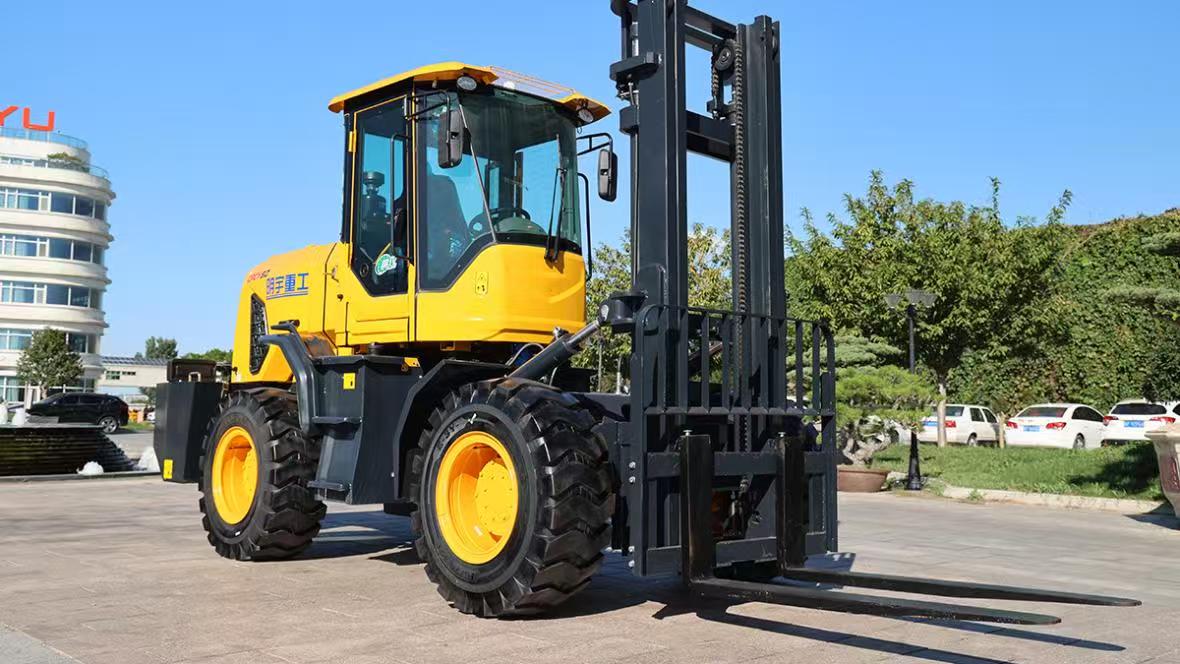
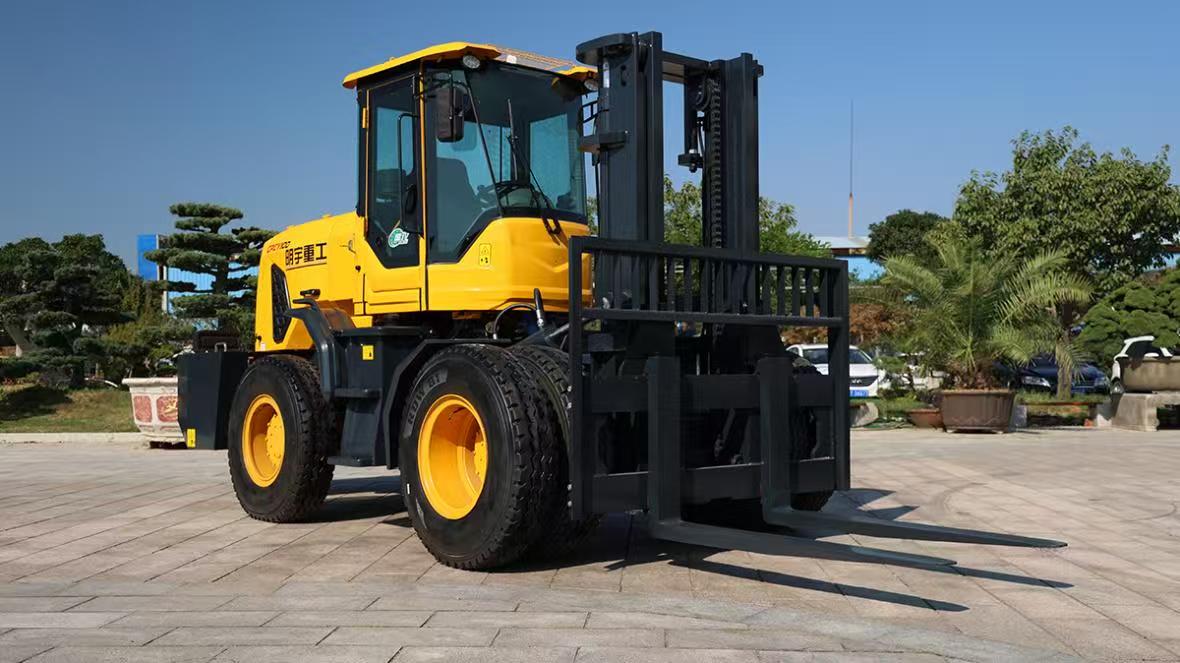
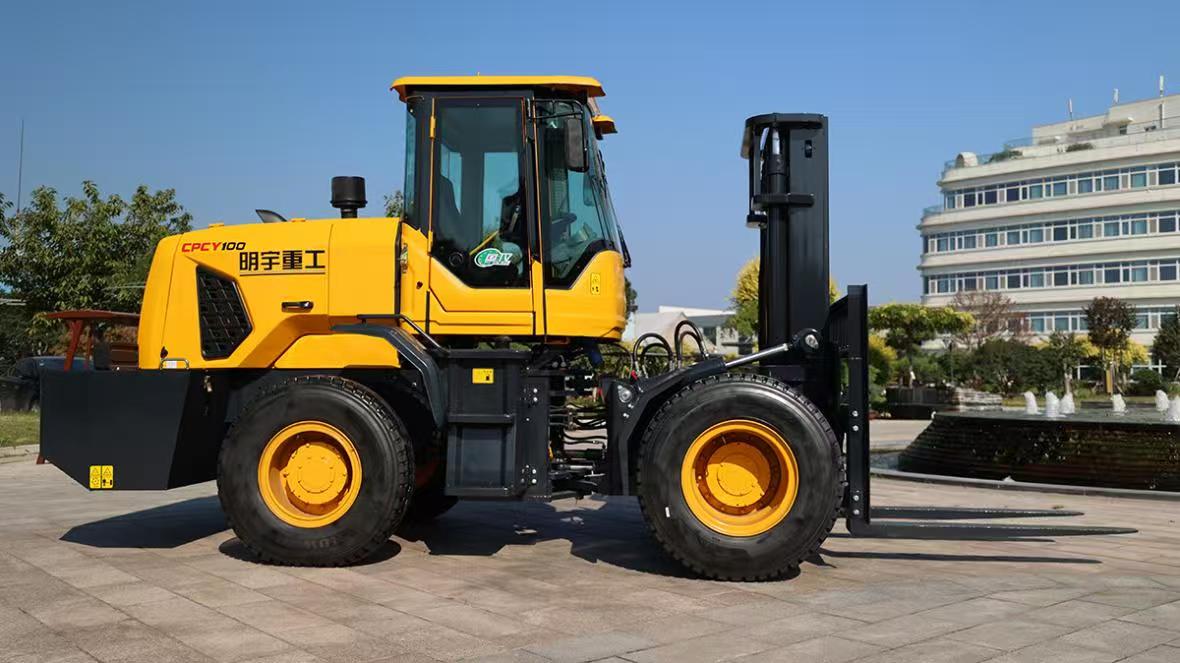
A rough terrain forklift is a material-handling machine designed specifically for outdoor environments where ground conditions are unstable or uneven. It is commonly used in construction sites, agricultural fields, logging operations, and mining zones.
Unlike indoor forklifts, these machines prioritize:
Traction
Stability
Ground clearance
Durability
2.2 Key Structural Features
Typical features include:
Large pneumatic off-road tires
High ground clearance for obstacles
Reinforced chassis structure
Powerful diesel engines
Four-wheel drive systems (in most models)
These design elements allow the forklift to move across uneven and soft surfaces more effectively than standard forklifts.
2.3 Types of Rough Terrain Forklifts
2WD rough terrain forklifts: Suitable for lighter outdoor work on relatively firm ground
4WD rough terrain forklifts: Better traction and stability for mud and slopes
Telehandler-style forklifts: Extendable boom for higher reach and flexible lifting
Articulated rough terrain models: Improved maneuverability in tight and uneven spaces
3. Understanding Terrain Challenges
3.1 Mud Conditions
Mud presents a combination of low traction and high sinkage risk. The surface may appear stable but can quickly collapse under machine weight, especially in wet or clay-rich soil.
3.2 Sand Conditions
Sand behaves differently depending on moisture content. Dry sand is loose and unstable, while wet sand is more compact but can still cause slipping or bogging down.
3.3 Steep Slopes (30% Gradient Explained)
A 30% gradient means the ground rises 30 units vertically for every 100 units horizontally. This equals roughly 16.7 degrees.
On forklifts, slope operation introduces:
Risk of tipping forward or sideways
Load shifting instability
Reduced braking efficiency
Increased rollover hazard
4. Can a Rough Terrain Forklift Work on Mud?
4.1 Light Mud Conditions
In shallow or semi-firm mud, a 4WD rough terrain forklift with deep-tread tires can operate effectively. Key factors include:
Tire tread design
Machine weight distribution
Controlled driving speed
4.2 Deep Mud Conditions
In deep or saturated mud:
Traction drops significantly
Wheels may spin without movement
Machine may become stuck
Recovery equipment may be required
4.3 Recommended Equipment for Mud
To improve performance:
Deep-lug mud tires
Differential lock systems
Reduced load operation
Low-speed high-torque driving mode
5. Can It Work on Sand?
5.1 Dry Sand Conditions
Dry sand is one of the most challenging surfaces. Machines may:
Sink under heavy loads
Lose directional control
Require wide tires to distribute weight
5.2 Wet Sand Conditions
Wet sand improves compaction but introduces:
Reduced maneuverability
Increased resistance when turning
Higher corrosion risk for components
5.3 Best Practices for Sand Operation
Reduce tire pressure if permitted by manufacturer
Use wider flotation tires
Operate with lighter loads
Avoid sudden steering movements
6. Performance on Steep 30% Slopes
6.1 Stability Limits of Forklifts
Stability depends heavily on:
Center of gravity
Load height
Load weight distribution
A higher lifted load dramatically increases tipping risk.
6.2 Driving Up and Down Slopes
Ascending slopes: Requires high torque and controlled speed
Descending slopes: Requires strong braking systems and engine braking control
6.3 Manufacturer Rated Gradient Limits
Most rough terrain forklifts are rated for:
20% to 40% slope capability depending on model
However, this rating is under ideal conditions, not fully loaded real-world operations.
7. Key Technical Factors That Determine Terrain Capability
7.1 Engine Power and Torque
Diesel engines are preferred because:
They provide high low-speed torque
They perform better under load stress
7.2 Drivetrain Systems
4WD systems significantly improve traction
Locking differentials help prevent wheel slip
7.3 Tire Selection
Pneumatic off-road tires provide better grip
Deep tread patterns improve mud and sand performance
7.4 Hydraulic Stability Systems
Load control systems improve safety
Telehandler boom stabilization reduces tipping risk
7.5 Frame Design and Weight Distribution
Lower center of gravity increases stability
Counterweights help balance lifted loads
8. Operator Skills and Safety Considerations
8.1 Importance of Experience
Experienced operators can:
Read terrain conditions
Adjust speed and load handling
Prevent dangerous maneuvers
8.2 Safe Driving Techniques
Operate at low speeds
Avoid sharp turns on slopes
Keep loads low during movement
8.3 Load Handling on Slopes
Never exceed rated load capacity
Always keep the load downhill-facing when descending
Avoid lifting loads while on incline
9. Real-World Applications
9.1 Construction Sites
Used for transporting materials across unfinished and unstable ground.
9.2 Agriculture
Common in farms, orchards, and muddy seasonal fields.
9.3 Mining and Quarry Operations
Used in rugged environments where durability is critical.
10. Limitations of Rough Terrain Forklifts
10.1 Unsuitable Conditions
They should not be used in:
Extremely deep mud
Soft desert dunes
Slopes beyond rated limits
10.2 Overestimation of Capability
Many buyers assume “rough terrain” means unlimited off-road ability, but:
Stability limits still apply
Physics cannot be bypassed
Safety rules remain critical
11. Comparison With Alternative Machines
Telehandlers: Better reach and slope control
Skid steer loaders: More agile in soft terrain
Wheel loaders: Better for heavy material movement in extreme conditions
12. Buying Guide
12.1 Matching Machine to Terrain
Agriculture: focus on traction and tire type
Construction: focus on power and durability
Mining: focus on reinforced structure
12.2 Checking Specifications
Verified slope rating
Drive system type
Tire configuration
12.3 Optional Upgrades
Mud tires
Enclosed cab
Enhanced braking systems
13. Maintenance in Harsh Conditions
Frequent cleaning of mud and sand buildup
Hydraulic system inspection
Tire wear monitoring
Regular undercarriage checks
14. Future Trends
Electric rough terrain forklifts
Smart traction control systems
Autonomous off-road navigation
Improved stability assistance technology
15. Conclusion
Rough terrain forklifts are capable machines designed for challenging outdoor environments, but their performance in mud, sand, and steep 30% slopes depends heavily on configuration, load conditions, and operator skill.
They can operate effectively in light to moderate mud and sand conditions and handle slopes up to around 30% under controlled conditions. However, extreme terrain, overload situations, or improper operation can quickly exceed their safety limits.
The key to successful operation is not only machine capability, but also correct usage, proper attachments, and strict adherence to manufacturer safety guidelines.
Post time:May.14.2026
