
What Maximum Lift Height Can a Standard Electric Walkie Stacker Reach?
1. Introduction
Electric walkie stackers have become one of the most widely used material handling solutions in warehouses, factories, retail distribution centers, supermarkets, and manufacturing facilities. Combining compact dimensions, electric-powered efficiency, and excellent maneuverability, these machines provide an economical alternative to forklifts for stacking pallets at medium heights while reducing operator fatigue and operating costs.
When purchasing an electric walkie stacker, one of the first questions buyers ask is: What maximum lift height can a standard electric walkie stacker reach? The answer depends on several factors, including mast configuration, load capacity, battery type, machine stability, and intended application. While many standard models lift between 1.6 and 3.5 meters, high-mast versions can reach 4.5 to 5.5 meters, making them suitable for higher warehouse shelving systems.
However, choosing the tallest mast is not always the best decision. As lifting height increases, lifting capacity, stability, visibility, and operating speed can all be affected. Selecting the correct lift height requires balancing your warehouse layout, pallet weight, aisle width, rack height, and daily workload.
This guide explains everything you need to know about the maximum lift height of electric walkie stackers, including mast types, capacity changes at height, safety considerations, and practical recommendations to help you choose the ideal machine for your business.
2. What Is an Electric Walkie Stacker?
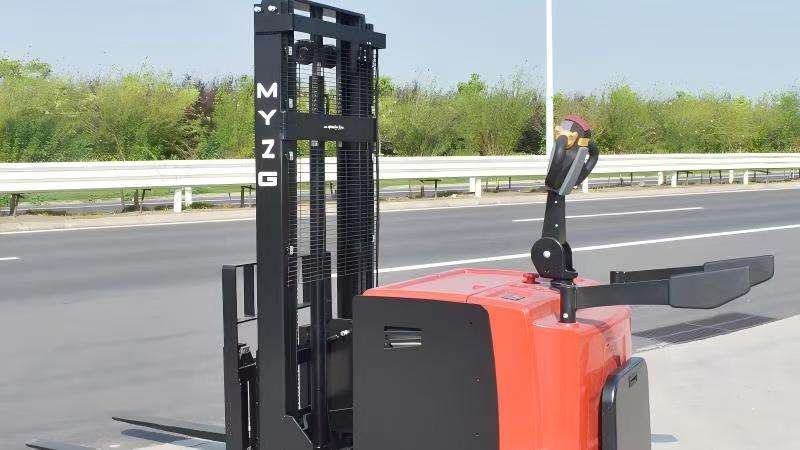
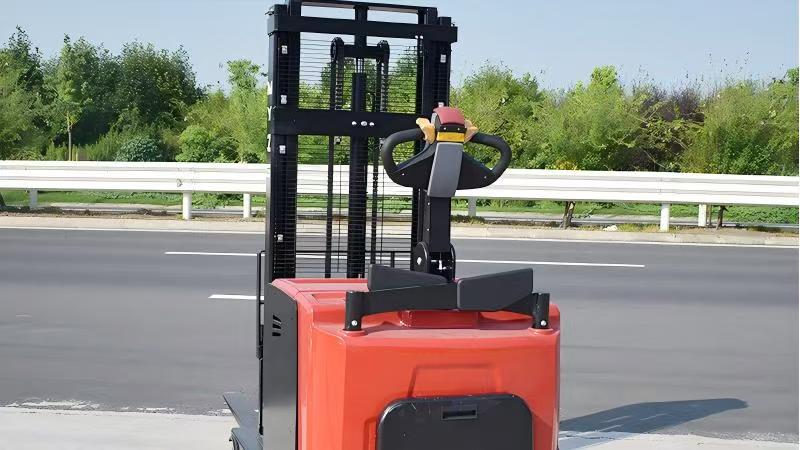
An electric walkie stacker is a pedestrian-operated warehouse truck designed for lifting, transporting, and stacking palletized goods over short distances. Unlike a forklift, the operator walks behind or alongside the machine while controlling travel and lifting functions using an ergonomic tiller handle.
Electric walkie stackers bridge the gap between manual pallet trucks and forklifts. They are ideal for businesses that require regular pallet stacking but do not need the speed, lifting capacity, or higher investment associated with traditional forklifts.
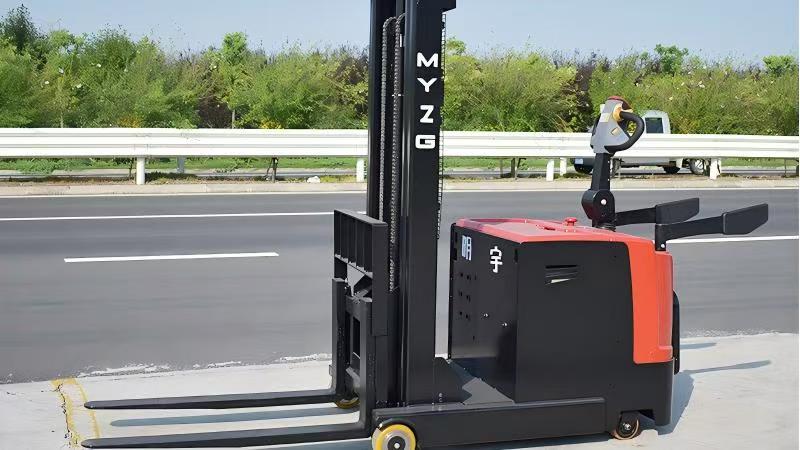
A typical electric walkie stacker consists of several major components:
Electric drive motor for forward and reverse travel
Hydraulic lifting motor and cylinder
Steel mast assembly
Fork carriage and forks
Battery pack (lead-acid or lithium-ion)
Electronic control system
Safety braking system
Steering handle with integrated controls
Modern models are available with either lead-acid batteries, which offer lower purchase costs, or lithium-ion batteries that provide faster charging, longer service life, and virtually maintenance-free operation.
Most standard electric walkie stackers have rated capacities ranging from 1,000 kg to 2,000 kg, making them suitable for handling standard warehouse pallets, packaged goods, construction materials, food products, pharmaceuticals, and retail inventory.
Compared with forklifts, walkie stackers offer numerous advantages:
Lower purchase price
Lower maintenance costs
Zero exhaust emissions
Quiet operation
Excellent maneuverability
Smaller turning radius
Reduced operator training requirements
However, they are designed primarily for indoor use on smooth floors and are not intended for rough outdoor terrain or long-distance transportation.
Understanding how these machines are built provides the foundation for understanding why different models can achieve different maximum lifting heights.
3. What Is the Maximum Lift Height of a Standard Electric Walkie Stacker?
The maximum lift height of an electric walkie stacker depends primarily on its mast design. Manufacturers offer various mast configurations to meet different warehouse storage requirements, from low-level shelving to high-density pallet racking.
Generally, standard electric walkie stackers are available in the following lift heights:
1.6 m (63 in): Suitable for low shelves, retail stores, and workshops.
2.5 m (98 in): Common for light warehouse applications.
3.0 m (118 in): One of the most popular options for general pallet stacking.
3.5 m (138 in): Ideal for medium-height warehouse racking.
4.0 m (157 in): Frequently used in logistics centers.
4.5 m (177 in): Designed for high-density storage.
5.0 m (197 in): Suitable for taller warehouse racks.
5.5 m (216 in): The upper limit for many standard high-mast electric walkie stackers.
Although some specialized models may exceed 5.5 meters, they are generally classified as high-lift warehouse stackers rather than standard electric walkie stackers.
The type of mast significantly influences maximum lift height:
Single-stage mast
Simple structure
Lower purchase cost
Limited lift height
Better visibility
Common lift height: 1.6–2.5 meters
Duplex mast
Two-stage telescopic design
Moderate overall collapsed height
Lift heights up to approximately 3.5–4.0 meters
Popular for general warehouse use
Triplex mast
Three-stage telescopic mast
Highest lifting capability
Lower collapsed mast height despite greater lift
Often selected for warehouses with low doorways but high storage racks
Lift heights commonly reach 4.5–5.5 meters
Another important specification is free lift, which refers to how high the forks can rise before the mast itself extends upward. Full free-lift masts are particularly valuable when loading containers, working inside trucks, or operating beneath low ceilings because they allow pallets to be raised without increasing the machine's overall height.
In most warehouses, a lift height between 3.0 and 4.5 meters provides the best balance between productivity, cost, and stability. Only facilities with taller racking systems typically require 5-meter or higher lift capacities.
4. Factors That Affect Maximum Lift Height
Several engineering and operational factors determine how high an electric walkie stacker can safely lift a load. Simply installing a taller mast does not automatically guarantee safe or efficient performance.
Mast Design
The mast is the most important component influencing lift height. High-strength steel sections, precision rollers, and reinforced guide rails allow the mast to remain rigid while carrying loads at elevated positions. Better mast designs reduce flexing and improve stability.
Rated Load Capacity
Every stacker has a maximum rated capacity, usually measured with a standard 600 mm load center. As the lifting height increases, the safe lifting capacity often decreases because the center of gravity moves upward, reducing stability.
Load Center Distance
Longer or irregularly shaped loads place additional stress on the mast. Even when the total weight is within the machine's rating, an extended load center may reduce the allowable lifting height.
Battery Weight
The battery serves not only as a power source but also as part of the machine's counterweight. Lithium-ion batteries are lighter than traditional lead-acid batteries, so manufacturers carefully design the chassis to maintain proper balance and stability.
Hydraulic System
The hydraulic pump, cylinders, hoses, and control valves determine how smoothly and efficiently the forks can be raised. High-quality hydraulic systems maintain consistent lifting speed even near maximum height while minimizing vibration.
Chassis and Wheelbase
A wider chassis and longer wheelbase improve machine stability, particularly when lifting heavy loads to greater heights. Compact models designed for narrow aisles may sacrifice some high-lift stability in exchange for maneuverability.
Floor Conditions
Electric walkie stackers are designed for smooth concrete floors. Uneven surfaces, expansion joints, ramps, or damaged flooring can significantly affect stability when the forks are fully elevated.
Operator Technique
Proper operation also plays a major role. Smooth acceleration, careful steering, and gradual lifting help maintain stability, while sudden turns or abrupt braking can increase the risk of load shifting or tipping.
Manufacturers carefully balance all of these factors during design and testing to ensure the stacker meets international safety standards while delivering reliable lifting performance.
5. Lift Height vs. Remaining Load Capacity
One of the most important concepts every warehouse manager and operator should understand is that maximum lift height does not always mean maximum lifting capacity. Although a walkie stacker may be rated to lift 1,500 kg or 2,000 kg, that rating is usually specified at a standard load center and under defined lifting conditions. As the forks rise higher, the effective lifting capacity often decreases.
The reason lies in basic physics. As the load is raised, the machine's center of gravity also rises. This creates greater leverage on the mast and chassis, reducing overall stability. To maintain safe operation, manufacturers specify different load capacities at different lifting heights through a load chart.
For example, consider a 1.5-ton electric walkie stacker:
At 2.5 meters, it may safely lift its full rated capacity of 1,500 kg.
At 4.0 meters, the recommended capacity may decrease to around 1,300–1,400 kg.
At 5.0–5.5 meters, the safe lifting capacity may be reduced further to 1,000–1,200 kg, depending on the mast design and load center.
These values vary between manufacturers, so operators should always consult the machine's load chart rather than assuming the rated capacity applies at every height.
Several factors influence capacity reduction at higher elevations:
Load center distance
Mast rigidity
Fork length
Chassis design
Battery weight
Hydraulic performance
Overall machine stability
To maximize safety when stacking at greater heights:
Keep the load evenly distributed across both forks.
Position the pallet fully against the fork carriage.
Lift only stable, properly wrapped loads.
Avoid lifting damaged or off-center pallets.
Raise and lower the forks smoothly without sudden movements.
Never exceed the manufacturer's rated capacity for the specific lift height.
Ignoring these precautions can lead to unstable loads, damaged racking, product loss, or even machine tip-over accidents. Understanding the relationship between lift height and remaining capacity is essential for both productivity and workplace safety.
6. Choosing the Right Lift Height for Your Warehouse
Selecting the correct lift height is about much more than simply choosing the tallest mast available. An oversized mast can increase purchase costs, reduce visibility, and add unnecessary weight, while an undersized mast may limit storage capacity and require future equipment upgrades.
The best lift height depends on your warehouse layout, storage system, pallet dimensions, and operational requirements.
Warehouses with Low Shelving
If your racks are below 2 meters, a stacker with a lift height of 1.6–2.5 meters is usually sufficient. These compact models are commonly used in:
Retail stores
Small warehouses
Workshops
Supermarkets
Manufacturing lines
They offer excellent maneuverability and are often the most economical option.
Medium-Height Storage
Warehouses with racking between 2.5 and 3.5 meters typically benefit from stackers with 3.0–3.5-meter lift heights. This range is considered the industry standard because it accommodates most pallet storage systems while maintaining good stability and visibility.
Typical applications include:
Third-party logistics (3PL) warehouses
Distribution centers
Food and beverage storage
Pharmaceutical warehouses
Spare parts inventory
High-Density Storage
Facilities with taller pallet racks often require lift heights of 4.0–5.5 meters. These stackers maximize vertical storage and reduce the need for warehouse expansion by making better use of available ceiling height.
High-lift stackers are commonly found in:
Large logistics hubs
E-commerce fulfillment centers
Cold storage warehouses
Industrial manufacturing plants
Export warehouses
Consider Ceiling Clearance
The mast's fully extended height is not the only dimension to consider. Buyers should also check the collapsed mast height to ensure the stacker can pass through doorways, loading docks, and low ceilings without obstruction.
Consider Aisle Width
Higher-capacity stackers often have larger dimensions. Before purchasing, verify that the machine can safely maneuver within your warehouse aisles and turning areas.
Plan for Future Growth
If your business expects increased inventory or higher storage racks in the coming years, investing in a slightly higher lift capacity today may reduce future replacement costs. However, avoid purchasing excessive lift height that will never be used, as it increases both acquisition and maintenance expenses without improving operational efficiency.
Ultimately, the ideal electric walkie stacker should match your warehouse's tallest storage rack while providing adequate lifting capacity, excellent maneuverability, and a strong safety margin for daily operations.
7. Benefits and Limitations of High-Lift Electric Walkie Stackers
High-lift electric walkie stackers have become an increasingly popular choice for businesses seeking to maximize warehouse efficiency without investing in larger and more expensive forklifts. While these machines offer significant advantages, they also have operational limitations that buyers should understand before making a purchase.
Benefits
Maximizes Vertical Storage Space
One of the greatest advantages of a high-lift walkie stacker is its ability to utilize vertical warehouse space. Instead of expanding the warehouse footprint, businesses can install taller pallet racking and store more inventory within the same building. This increases storage density while reducing facility costs.
Lower Investment Than Forklifts
Electric walkie stackers generally cost considerably less than counterbalance forklifts or reach trucks. They also require less maintenance, making them an excellent solution for small and medium-sized businesses with limited budgets.
Compact Design
Walkie stackers are specifically designed for confined warehouse environments. Their compact chassis and small turning radius allow operators to work efficiently in narrow aisles where larger forklifts may struggle to maneuver.
Reduced Operating Costs
Electric power eliminates fuel expenses and significantly lowers routine maintenance requirements. There are no engine oil changes, fuel filters, or exhaust systems to maintain. Lithium-ion battery models further reduce downtime with opportunity charging and maintenance-free operation.
Environmentally Friendly
Since electric walkie stackers produce zero exhaust emissions during operation, they are ideal for indoor environments such as food processing facilities, pharmaceutical warehouses, cold storage, and clean manufacturing plants. Their quiet operation also improves workplace comfort.
Easy Operator Training
Compared with forklifts, walkie stackers are generally easier to operate. Their intuitive controls and pedestrian operation reduce the learning curve for new operators, helping businesses improve productivity while maintaining safety.
Limitations
Despite their many advantages, high-lift electric walkie stackers are not suitable for every application.
Reduced Capacity at Maximum Height
As discussed earlier, lifting capacity typically decreases as lift height increases. Operators must always follow the manufacturer's load chart to prevent overloading and ensure safe operation.
Slower Travel Speed
Walkie stackers are designed for short-distance transport rather than long-distance material movement. Their travel speed is considerably lower than that of ride-on forklifts, making them less suitable for large distribution centers with long travel routes.
Indoor Use Only
Most electric walkie stackers perform best on smooth concrete floors. Rough terrain, gravel, potholes, mud, and steep slopes can negatively affect stability, traction, and overall safety.
Limited Performance on Inclines
Although some models can handle moderate ramps, they are not intended for frequent operation on steep inclines. Heavy loads combined with gradients can reduce traction and place additional strain on the drive system.
Operator Fatigue During Long Shifts
Because the operator walks with the machine, continuous use over long distances may lead to fatigue. For high-volume operations involving frequent travel, a ride-on stacker or reach truck may provide better productivity.
Visibility at High Lift
When stacking at heights above four meters, the operator's visibility of the pallet and rack decreases. Careful positioning, adequate warehouse lighting, and proper operator training become increasingly important to prevent product or rack damage.
Understanding both the strengths and limitations of high-lift walkie stackers enables businesses to select equipment that best matches their operational needs.
8. Tips for Safe Operation at Maximum Lift Height
Operating an electric walkie stacker at or near its maximum lift height requires careful attention to safety. While modern machines incorporate numerous safety features, safe performance ultimately depends on proper operation, routine maintenance, and adherence to manufacturer guidelines.
Perform Daily Equipment Inspections
Before each shift, inspect the stacker for any signs of wear or damage. Check the hydraulic hoses, mast rollers, forks, battery, wheels, brakes, emergency stop button, and steering controls. Any abnormal noises, hydraulic leaks, or damaged components should be repaired before the machine is used.
Follow the Load Chart
Every stacker is supplied with a capacity plate or load chart that specifies the maximum allowable load at different lift heights. Operators should never assume that the rated capacity remains constant throughout the lifting range.
Center the Load Properly
Always place the pallet evenly on both forks and ensure it is fully against the fork carriage. Off-center or unbalanced loads increase the risk of tipping, especially at maximum lift height.
Lift on Level Floors
Electric walkie stackers should only raise loads to full height on flat, stable surfaces. Uneven flooring can significantly reduce stability and increase the likelihood of accidents.
Travel with Forks Lowered
After retrieving or placing a pallet, lower the forks to a safe travel position before moving. Driving with elevated loads raises the center of gravity and reduces stability during turning or braking.
Avoid Sudden Movements
Smooth acceleration, gentle steering, and gradual braking help maintain machine stability. Sharp turns or sudden stops while carrying elevated loads should always be avoided.
Keep Clear of Overhead Obstacles
Before lifting to maximum height, ensure sufficient clearance from ceilings, lighting fixtures, sprinkler systems, pipes, overhead doors, and structural beams. Contact with overhead objects can damage both the warehouse and the equipment.
Inspect Pallet Condition
Never lift damaged, cracked, or unstable pallets to high storage levels. A weak pallet may fail during lifting, creating a serious safety hazard.
Train Operators Regularly
Even experienced warehouse personnel benefit from periodic safety training. Operators should understand machine limitations, emergency procedures, battery charging practices, and proper stacking techniques to reduce accidents and extend equipment life.
By following these best practices, businesses can safely maximize the performance of their electric walkie stackers while minimizing downtime, product damage, and workplace injuries.
9. Conclusion
The maximum lift height of a standard electric walkie stacker typically ranges from 1.6 meters to 5.5 meters, depending on the mast configuration, rated capacity, and manufacturer. While taller masts provide greater storage flexibility and improved warehouse space utilization, they also require careful consideration of load capacity, machine stability, and operator safety.
For most warehouses, lift heights between 3.0 and 4.5 meters offer the best balance of performance, cost, and versatility. Facilities with high-density pallet racking may benefit from 5.0- to 5.5-meter models, provided that operators follow the manufacturer's load charts and safe operating procedures.
When selecting an electric walkie stacker, buyers should evaluate more than just the maximum lift height. Factors such as pallet weight, aisle width, ceiling clearance, battery type, mast design, daily operating hours, and future warehouse expansion all play an important role in choosing the right machine.
A well-matched electric walkie stacker can significantly improve warehouse productivity, reduce manual handling, lower operating costs, and maximize storage capacity for years to come. By understanding how lift height affects capacity, stability, and efficiency, businesses can make an informed investment that supports both current operations and long-term growth. Whether your warehouse requires low-level pallet stacking or high-density storage, selecting the appropriate lift height ensures safer operations, better space utilization, and higher overall productivity.
Post time:Jun.26.2026
