
What Is the Difference Between Manual, Semi-Electric and Full-Electric Stackers?
1. Introduction
As warehouses, distribution centers, retail stores, and manufacturing facilities continue to modernize, the demand for efficient material handling equipment has increased significantly. Businesses are constantly searching for ways to improve productivity, reduce labor costs, and maximize warehouse space utilization. One of the most commonly used pieces of equipment for handling pallets and stacking goods at various heights is the pallet stacker.
Stackers serve as an economical alternative to forklifts, especially in small and medium-sized warehouses where space is limited and lifting requirements are moderate. They are widely used for loading and unloading pallets, organizing inventory, transporting materials, and stacking goods on warehouse racks. However, not all stackers are the same. Depending on operational requirements and budget, businesses can choose between manual stackers, semi-electric stackers, and full-electric stackers.
Each type offers unique advantages and disadvantages. Manual stackers are simple and affordable but require significant operator effort. Semi-electric stackers reduce physical strain by using electric lifting systems while still requiring manual movement. Full-electric stackers provide maximum efficiency with powered lifting and travel functions but come at a higher initial investment cost.
Choosing the right stacker can significantly affect warehouse productivity, labor efficiency, maintenance costs, and overall operational performance. Understanding the differences between these three types of stackers is essential for making an informed purchasing decision.
This article provides a detailed comparison of manual, semi-electric, and full-electric stackers, covering their working principles, performance, costs, advantages, limitations, and ideal applications.
2. What Is a Manual Stacker?
A manual stacker is the simplest and most economical type of pallet stacker. It relies entirely on human power for movement and uses a hydraulic system for lifting loads. The operator manually pushes, pulls, and steers the stacker while pumping a handle or foot pedal to raise the forks.
Manual stackers are commonly used in warehouses with light-duty material handling requirements. Their simple design typically includes a mast, forks, hydraulic cylinder, steering wheels, and load wheels. Because they do not require batteries or electric motors, they are relatively easy to maintain and operate.
Most manual stackers offer load capacities ranging from 500 kg to 2,000 kg and lifting heights from 1.6 meters to 3 meters. They are ideal for occasional pallet stacking, inventory organization, and loading tasks in small warehouses, workshops, and retail environments.
One of the main advantages of manual stackers is their low purchase price. They are often the most affordable lifting solution available. Additionally, because they do not rely on batteries or electrical components, they can be used continuously without charging requirements.
However, manual stackers require significant physical effort. Operators must manually move the machine and pump the lifting mechanism, making them less suitable for intensive daily operations or heavy loads.
3. What Is a Semi-Electric Stacker?
A semi-electric stacker combines manual movement with electric lifting functionality. In this design, the operator still pushes and steers the machine manually, but an electric motor powers the hydraulic lifting system.
Semi-electric stackers are equipped with batteries, electric motors, hydraulic pumps, and control switches that simplify lifting operations. Instead of manually pumping a handle, operators simply press a button to raise or lower the forks.
These stackers generally offer capacities between 1,000 kg and 2,000 kg and lifting heights up to 5 meters or more. They are widely used in medium-sized warehouses where lifting tasks are frequent but transportation distances are relatively short.
The primary advantage of semi-electric stackers is reduced operator fatigue. Electric lifting eliminates repetitive pumping actions, increasing productivity and improving workplace ergonomics. Operators can handle more pallets throughout the workday with less physical strain.
Although semi-electric stackers improve lifting efficiency, manual travel still limits overall productivity. Moving heavy loads over long distances can remain challenging, especially on uneven surfaces or warehouse ramps.
4. What Is a Full-Electric Stacker?
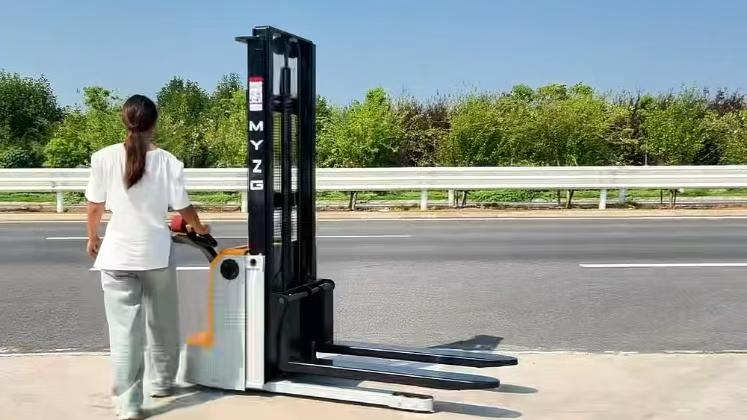
A full-electric stacker uses electric power for both lifting and traveling functions. The machine is equipped with drive motors, hydraulic lifting motors, batteries, and electronic control systems that allow operators to move and lift loads with minimal physical effort.
Full-electric stackers are designed for high-frequency warehouse operations where efficiency and productivity are critical. Operators control the machine through a handle-mounted control system that manages travel speed, lifting functions, steering, braking, and safety features.
Modern full-electric stackers are available with load capacities ranging from 1,000 kg to 2,500 kg and lifting heights exceeding 6 meters. Many models include advanced features such as proportional lifting controls, regenerative braking, electronic steering assistance, and battery management systems.
Because all major functions are powered, operators can transport and stack pallets quickly and efficiently. This makes full-electric stackers particularly suitable for logistics centers, manufacturing facilities, e-commerce warehouses, and high-volume distribution operations.
While full-electric stackers require a higher initial investment, they often deliver significant long-term savings through increased productivity, reduced labor costs, and improved operational efficiency.
5. Key Differences Between Manual, Semi-Electric and Full-Electric Stackers
The most important difference among these stackers is the level of power assistance they provide. Manual stackers rely entirely on human effort, semi-electric stackers use electric power for lifting only, and full-electric stackers use electric power for both lifting and travel.
This distinction directly impacts productivity. Manual stackers are suitable for low-frequency operations, semi-electric stackers offer moderate efficiency improvements, and full-electric stackers maximize handling speed and throughput.
Operator fatigue also varies significantly. Manual stackers require the highest level of physical effort, while full-electric stackers greatly reduce operator workload. Semi-electric models fall somewhere in between.
Maintenance requirements increase with equipment complexity. Manual stackers require mainly hydraulic maintenance, while electric models also require battery care, electrical inspections, and motor servicing.
These differences influence purchasing decisions depending on warehouse size, workload, and budget.
6. Performance Comparison
When comparing performance, load capacity is often similar among the three categories, with most models supporting between 1 and 2 tons. However, actual productivity differs significantly.
Manual stackers are slower because both travel and lifting functions depend on operator effort. Semi-electric stackers improve lifting speed but still require manual transportation. Full-electric stackers provide the fastest operation by powering all movement functions.
Lift height also varies. Manual stackers generally offer lower lift heights, while semi-electric and full-electric models can reach much higher storage locations.
Battery-powered models offer greater consistency throughout the workday. A fully charged battery can often support 6 to 10 hours of operation, depending on load conditions and usage intensity.
In narrow warehouse aisles, full-electric stackers often provide superior maneuverability due to powered controls and optimized turning characteristics.
7. Advantages and Disadvantages of Each Type
Advantages:
Lowest purchase cost
Simple mechanical design
Minimal maintenance requirements
No battery charging needed
Suitable for occasional use
Disadvantages:
Labor-intensive operation
Lower productivity
Increased operator fatigue
Limited suitability for high-volume operations
Semi-Electric Stacker
Advantages:
Reduced lifting effort
Improved efficiency compared to manual models
Moderate investment cost
Better ergonomics
Disadvantages:
Manual travel still required
Battery maintenance needed
Limited productivity improvements compared to full-electric models
Full-Electric Stacker
Advantages:
Highest productivity
Minimal operator effort
Suitable for intensive daily use
Advanced safety and control systems
Improved operational efficiency
Disadvantages:
Higher purchase price
Battery charging infrastructure required
More complex maintenance procedures
8. Cost Comparison and Return on Investment (ROI)
Purchase price varies significantly among stacker types. Manual stackers are typically the least expensive, while full-electric models require the highest upfront investment.
However, initial purchase price should not be the only consideration. Operating costs, labor savings, maintenance expenses, and productivity improvements all contribute to the total cost of ownership.
Manual stackers have low maintenance costs but higher labor costs due to reduced efficiency. Semi-electric stackers offer a balance between affordability and performance.
Full-electric stackers often provide the best long-term return on investment in high-volume operations. Increased productivity, reduced labor requirements, and improved workflow efficiency can quickly offset the higher purchase price.
Businesses should evaluate expected daily usage, labor rates, and operational goals when calculating ROI.
9. Which Stacker Is Best for Your Business?
For small retail stores, workshops, and low-volume warehouses, manual stackers are often sufficient. They provide an affordable solution for occasional lifting and stacking tasks.
Medium-sized warehouses that handle pallets regularly but have limited transportation distances may benefit from semi-electric stackers. These machines reduce physical strain while keeping costs manageable.
Large warehouses, logistics centers, and manufacturing facilities typically achieve the greatest benefits from full-electric stackers. High productivity, fast travel speeds, and reduced labor demands make them ideal for intensive operations.
Cold storage facilities and specialized manufacturing environments may also prefer electric stackers due to their efficiency and ease of operation.
Ultimately, the best choice depends on workload, budget, warehouse layout, and long-term business objectives.
10. Safety Considerations for Stacker Operations
Regardless of the stacker type, safe operation is essential. Operators should receive proper training and understand load capacity limits before using any equipment.
Loads must always be centered correctly on the forks to prevent tipping or instability. Operators should avoid sudden movements and maintain clear visibility when transporting materials.
Electric stackers require additional attention to battery charging safety. Charging areas should be properly ventilated, and batteries should be inspected regularly for damage or leaks.
Daily inspections should include checking forks, wheels, hydraulic systems, controls, brakes, and battery condition. Preventive maintenance helps reduce downtime and improves workplace safety.
Compliance with local workplace safety regulations should always remain a priority.
11. Frequently Asked Questions (FAQ)
What is the cheapest type of stacker?
Manual stackers are generally the most affordable option.
Is a semi-electric stacker worth the extra cost?
Yes, especially when lifting operations are frequent and operator fatigue is a concern.
How long does a full-electric stacker battery last?
Most batteries provide between 6 and 10 hours of operation under normal conditions.
Can manual stackers lift heavy pallets?
Yes, many models can handle loads up to 2,000 kg, although operator effort increases significantly.
Which stacker is best for narrow aisles?
Full-electric stackers often provide superior maneuverability in confined warehouse spaces.
Are electric stackers difficult to maintain?
Not necessarily, but they require battery care and periodic electrical inspections.
What lift height should I choose?
The required lift height depends on your warehouse racking system and storage requirements.
Which stacker offers the best value for money?
For most medium-sized warehouses, semi-electric stackers often provide the best balance between cost and performance.
12. Conclusion
Manual, semi-electric, and full-electric stackers each serve important roles in modern warehouse operations. Manual stackers offer affordability and simplicity, making them ideal for light-duty applications. Semi-electric stackers improve efficiency and reduce operator fatigue while maintaining a reasonable investment cost. Full-electric stackers deliver maximum productivity, minimal labor effort, and the highest operational efficiency.
The best stacker for your business depends on workload, warehouse size, handling frequency, and budget. By carefully evaluating these factors, businesses can select the equipment that provides the greatest productivity, safety, and return on investment over the long term.
Post time:Jun.16.2026
